
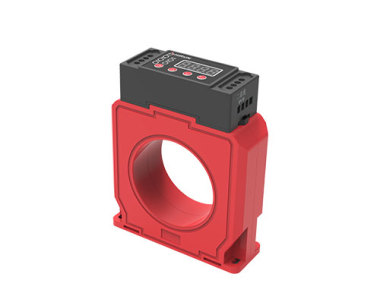
The product is suitable for places with complex circuits such as factories, large warehouses, offices, commercial buildings, hotels, residences and entertainment venues where electrical fires are most likely to occur.
The main cause of electrical fires is electrical short circuits, including phase-to-phase short circuits and single-phase ground short circuits. Phase-to-phase short circuits can generally generate large short circuit currents, causing overcurrent protection devices to operate and cut off the power supply in time, so electrical fires rarely occur. Single-phase ground short circuits can be divided into metallic short circuits and arc short circuits. Metallic short circuits have little fire risk mainly because the short circuit current is large and the overcurrent protection device cuts off the power supply in time under the action of the short circuit current. Arc short circuits have poor contact at the fault point and are not melted, resulting in arcs or sparks. Since the fault point impedance is large when arc short circuits occur, it is difficult for circuit breakers to operate, causing the arc to persist. According to measurements, arcs generated by currents slightly greater than 0.5 A can reach temperatures of 2,000 to 3,000°C, which can ignite any combustible material, and the arc maintenance voltage can be as low as 20 V to maintain a continuous and stable arc. Therefore, arcs from arc short circuits often become the ignition source of electrical fires.
Electrical fire monitoring detectors can detect dangerous parameters such as residual current and temperature in electrical circuits, and issue audible and visual alarm signals according to the set alarm value, and form an electrical fire monitoring system with the electrical fire monitoring equipment through a communication network. Electrical fire monitoring detectors include residual current detection and temperature detection. Electrical fire monitoring detectors and electrical fire monitoring equipment can form different electrical fire monitoring systems to adapt to different occasions, different capacities and different customer needs.